
MATA AI turns plain-language rules into evidence-backed alerts from existing cameras, live or from recorded video, with sampling, screening and budget controls that keep running costs in check.
MATA AI brings AI CCTV analytics to Malaysian sites without new camera hardware. Your team describes what matters in plain words, such as “tell me when something blocks the walkway”, connects a supported live feed or uploads recorded video, and reviews each alert against its captured evidence. No model needs training for each new rule.
How plain-language rules work on existing CCTV
Start with the feed. MATA is camera-brand agnostic and connects through a supported browser, USB, RTSP, HTTP/MJPEG or push-frame source. Closed systems may need an accessible stream or integration, and the team checks your actual feed during setup.
Take a hypothetical warehouse. The facilities supervisor types “Tell me when something blocks the walkway”, draws a region over the loading-area aisle and requires a sustained condition. A box set down for a moment is then less likely to pull staff off the floor.
On Save, Auto Enhancement prepares visual instructions, examples and a screening question. Operator override protects exact wording, and the operator’s rule stays the authority: generated guidance cannot narrow it or add to it.
The supervisor then chooses how the rule reads footage:
- Still-image rule: checks one frame for a visible condition.
- Event check: collects 1 to 10 seconds of footage and evaluates sampled images in order.
- Reviewed sequence: follows a series of visible steps.
Alerts can be immediate, repeated, persistent or continuous, with cooldowns per rule. When one arrives, the supervisor checks the screenshot, timestamp, camera and region before sending anyone.
Keeping alerts timely and running costs under control
MATA samples rather than analysing every frame. Live checks default to one every five seconds, and each rule can run from 0.1 to 10 checks per second. Brief events can fall between samples, so match the rate to how long the situation usually lasts.
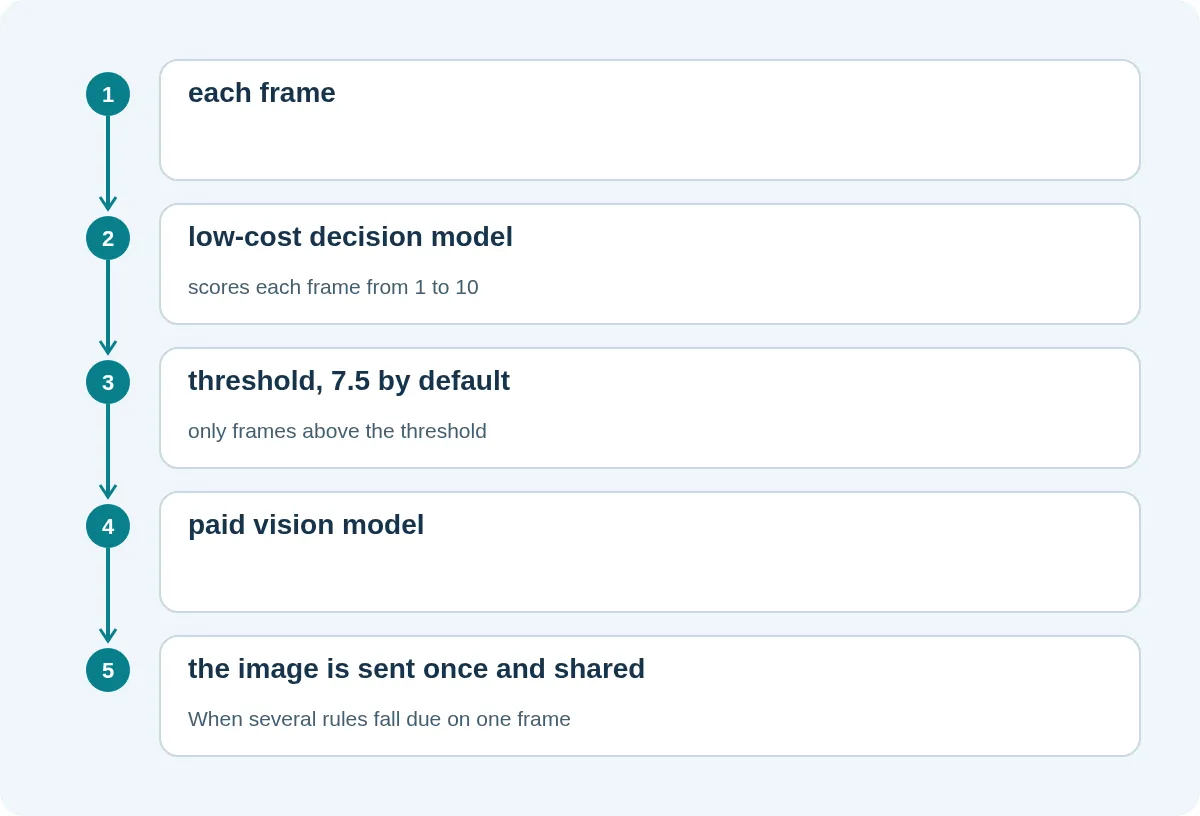
Screening keeps spend sensible. A low-cost decision model scores each frame from 1 to 10 for each rule, and only frames above the threshold, 7.5 by default, reach the paid vision model. When several rules fall due on one frame, the image is sent once and shared.
- Motion-based sampling: an optional mode checks motion locally and samples occasionally when the scene is quiet.
- Drawn regions: limit what the model sees.
- Duplicate frames: never become new paid samples.
- Monthly budget cap: enforced before each request, not just displayed.
Each run shows its estimated cost, usage breakdown and projections, so spending is visible as it builds.
Now picture a hypothetical retail outlet manager. Using MultiInput, the manager tiles up to eight supported feeds into one view and binds rules such as “counter is empty” and “queue grows” to camera regions. Alerts go to Telegram or a webhook, with evidence tied to the original camera. The mosaic saves requests, but a single full-size camera detects better, so the cashier counter keeps its own view.
Behind the scenes, bounded queues stop a backlog building behind live video, stale work is dropped rather than raising late alerts, and results publish in capture order. A skipped or failed check never counts as proof that nothing happened.
Have questions? Get in touch with our team to talk through how this fits your business. Contact us.
Recorded footage, reports and Malaysian privacy choices
Live monitoring is optional. A hypothetical clinic or school operations lead uploads recorded video for offline review, then generates observation digests. Each completed run with accepted alerts gets a report showing the matched rule, severity, date and time, camera, score and screenshot. Reports and PDF exports are generated locally, adding no AI inference cost, and later rule edits do not rewrite what matched at the time.
Before analysis, the lead applies privacy masks to black out areas the rule does not need. Next comes hosting: MATA can run on your own server or LAN with a supported vision backend. Cloud routes send sampled images to their providers, so review each provider’s terms on retention, training use and cross-border transfer first.
The Personal Data Protection (Amendment) Act 2024 sharpens these decisions. Biometric data is now sensitive personal data. A data controller with reason to believe a breach has occurred must notify the Commissioner as soon as practicable, and data controllers must appoint data protection officers. Take legal advice on how these duties apply to your site.
Core situation monitoring does not require identifying anyone. Set a retention policy and make sure deleting an alert also deletes its evidence. Treat scores as uncalibrated model ratings, not accuracy percentages, test each rule on representative footage, lighting and camera angles, and keep a person in the review loop.